

How do you approach a job search with an Agile mind? In this article Mark Haynes discusses how to plan your quest for a new job using the Scrum framework and concepts like sprints or user stories..
Author: Mark Haynes, https://www.linkedin.com/in/donald-mark-haynes-csm-745a609/
Think small and incrementally. Keep the big picture in mind, but focus on tasks you can accomplish in a few hours a day. Concentrate on one doable task at a time. Give yourself small assignments, then work them to completion, and move on to the next. Don’t obsess over things that will take months, or anything you have already accomplished. If you need to revisit it, then do that as a separate task.
The job search, skill assessment, and skill development are all interrelated. Don’t get trapped rationalizing that you need more experience before you apply. Ask: How do I get experience? This is an excellent time to conduct a skills assessment and create a career development plan. Create a list of targeted skills. Think tools, techniques, and experience. Look for opportunities to pursue them. Constantly changing goals will lead to a spiral of self-doubt and indecision as you hit roadblocks. Pick a path. If you choose multiple paths, then work on them separately.
Where do you start? It doesn’t matter. What matters is that you start now. There are jobs available, even in a bad economy. When is it a good time to look for a job? Always. You need market data. It gives a perspective on what skills potential employers are looking for. It can keep you optimistic. If you’re stuck in a dead-end job, the best solution is to start looking for a new one. Persistence pays off.
Strategy vs. Tactics
It’s a balancing act between strategy and tactics. On the one hand, cast a wide net. Spend some of your time exploring alternatives. A job search is a great opportunity to explore your future. Scrum teams work on prioritized functionality and must allocate resources accordingly. They should also allocate a few user stories to research and explore new opportunities.
Tactically, focus on a targeted approach. It’s a question of resource management. Create a series of objectives. Break them down into tasks. Prioritize the tasks and work on each one individually until it’s done. Once complete, move on to the next task. If a task needs more work, create a new task and move it to DONE. Continuously reworking an issue is a trap. Each task brings you closer to your objective. Let success build upon success.

Key points:
- Spend time exploring possibilities. Research future jobs.
- Submit on jobs that are only a partial fit.
- Approach job search in a targeted, tactical way
Value
Time is your most valuable commodity. Research, interview prep, writing resumes and cover letters will consume most of it. The remainder is for the actual job search. Not that these don’t have value. The true value is in the interview itself. Your goal is to put yourself in front of as many hiring managers as you can.
The Sprint
Pick a time interval to schedule work. No more than one to a few weeks. Start by planning tasks you can reasonably accomplish. Every few days, review your accomplishments and impediments with a friend or associate. Schedule a day at the end of the sprint to review what you have accomplished. My day is Sunday, just before my gaming group meets. We discuss our writing and agile topics. This will keep you focused. This is a good time to review your metrics. You may find that your current approach is ineffective. It may be time to pivot and try something completely different, or tweak your approach.
Metrics
Pick metrics that will help keep you focused. You could track the number of jobs submitted, phone calls made, and interviews per week. Additional metrics might be useful feedback on contacts and new leads. Set a goal for each. Your goal is to keep the pipeline flowing. Never put all your chips on one job possibility. What’s your velocity?
Velocity
A Scrum team tracks velocity. Why not track your job hunt velocity? What’s your bandwidth? Can you spend two hours a day and five hours on the weekend? That’s 35 hours per week. Spending 50 to 60 hours per week may be doable, but beware of burnout. That path leads to frustration and diminished results. This isn’t a short-term endeavor. Pace yourself. Results are never guaranteed, but persistence will pay off. Use prioritized tasks in your Kanban board and track your results.
User stories
These are tasks you have assigned yourself to accomplish your goals. They should take only a few hours. If it takes a week or two, then break it down into shorter tasks.
You don’t have to follow the User Story format; at minimum, include a few simple items.
- Identification. This is a one-sentence statement of the task.
- Description. A short paragraph of the task.
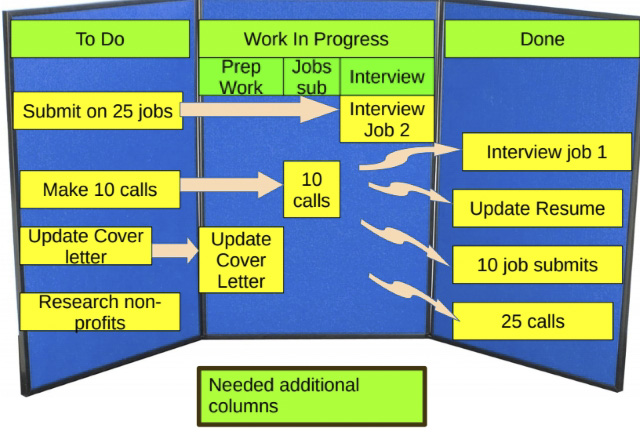
If you need to take notes, then add a comments section. Add or remove columns as appropriate. Maybe you need a column for:
- Resume/Cover letter preparation.
- Interview preparation.
- Job submissions
I don’t use story points for my tasks (i.e., the degree of complexity). I keep them simple; therefore, they are all ones or threes.
Task Scheduling
Create a Kanban board. This is a modified to-do list. I use Trelo. It’s free and easy to use. Keep it simple. It should have three main sections: To Do, Work in Progress, and Done. You move the card from one section to the next as you complete it.
- To Do is your prioritized list. If it isn’t your top priority, then change the order.
- Work in Progress (WIP) is what you are currently working on. Work on one item at a time.
- Done is where you move completed tasks.
You need to define a few terms.
- Ready. Meets your acceptance criteria to start working on the task. If it’s not ready, check for dependencies and set up additional tasks that are Ready.
- Acceptance Criteria. What are your criteria for when a task is ready or done?
Skill Development
Developers typically need a few technologies to build in any particular software stack. Exploring multiple languages, databases, and techniques will give you a depth of understanding that might prove valuable in your career and your job search. Look for opportunities to pursue this in your current job. If you can discuss the pros and cons of various tools, packages, and techniques during an interview, it will demonstrate your versatility.
Try carving out a few hours during the day for personal development. You work an eight-hour day. Now you are working a ten-hour day. Two of them are for you. Come in one hour early and work on skills development. If we are using a Kanban board I’m not familiar with, then I spend that hour reviewing its features or taking tutorials.
Can you only spend a few hours a week job hunting? If your search is in hobby mode, then focus on researching opportunities. Occasionally submit to a few jobs. Are you completely satisfied with your current situation and have zero interest in looking for a job? Does that mean you have to stop learning? Consider doing a knowledge project. Is there a subject you want to learn about? Information is often free or low-cost. You could take tutorials, study for a certification, pursue internal training, take adult learning courses, browse the internet, or just read about it. Go where curiosity leads you. Find a good outline of the material, and work your way through it. Use the agile techniques described above to keep yourself focused and track your results. A useful goal is to become the go-to guy. You will become a valued asset.
Targeted search
Targeting depends upon your career needs and personal requirements. Don’t limit yourself too much, at least initially. Remember, this is also an exploration of possibilities. I’ve briefly identified a few target criteria. They may not all fit your situation.
Physical environment
How important are your mobility issues in your job search? Access to parking, the workspace, and personal security when walking late at night will all impact your decision.
Location
Don’t constrain your search too much. Expanding the criteria will increase opportunities and your perspective. A 15-minute commute significantly reduces the opportunities. If this is your criterion, then look for remote work. The trend is to require working on-site. Consider a four-tiered search pattern.
The first tier is a short commute, for example, 45 minutes. Opportunities may be limited, but keep a list of companies and check them periodically.
The second tier is your maximum daily commute, for example, 1 1/2 hours. That may put you in range of several different job markets. It’s not ideal, but it greatly expands the job search. After achieving your objectives, reconsider your commute needs.
The third tier is your maximum total travel time or distance, for example, 300 miles. You may have to rent an apartment and commute home on the weekends. It’s the cost of doing business. Can you afford two living spaces and a long drive back home? If the job looks good, consider relocating.
The final tier is everything else. Keep in mind your goal is to find opportunities that build skills. Always research what’s involved with your decision. Travel and accommodations are only part of your expenses.
Types of institutions
What sectors are you looking at? Have you considered for-profit, non-profit, and government jobs? Federal, state, and local governments have a variety of jobs. These have very different procurement processes. Attrition might be slow, but eventually, people retire.
Culture
People have reputations, and so do institutions. How do they treat their employees, compensation, problem resolution, and personal growth? Check out its reputation. Use internet tools and get evaluations. If the work they do, although perfectly legal, doesn’t align with your beliefs, then don’t apply.
Size
Large is not necessarily bad. Big organizations often provide better training, established procedures, and expectations. Once you have spent sufficient time in grade, look for opportunities in other departments. You will have to live in siloed, bureaucratic institutions. How good are you at navigating the bureaucracy? Artificial barriers will greatly impede your ability to implement change and new ideas.
Small companies don’t need specialists as much as they need people to pitch in and help. This can be a great opportunity to gain new skills. They may be more entrepreneurial and offer a value-rich experience. Small companies can also be rigid, especially family-run businesses. Family members have a guaranteed career path. You don’t.
Start-ups. This can be exciting work. It may offer bonuses to attract employees. The hours may be very long, and salaries may be lower. When you are young and don’t have a family to support, this may provide many opportunities.
The position
Once your filters are in place, create a list of your favorites. Many similar jobs have different names. Many job titles are actually synonyms. Identify the job names for your keyword search. Take some time and check out their websites. If you are a Scrum Master or Agile Coach, are they committed to an agile philosophy? Check back periodically. Eventually, they will need to hire you. Are you registered on their jobs website?
Target Skills
Identify required skills, responsibilities, and general capabilities. Don’t fall into the trap of matching them perfectly. Their hiring manager’s needs may be very different than what they actually need. A wish list, especially if generated by HR, will only obscure this requirement. Your goal is to eliminate the noise and platitudes from blogs and boilerplate job requirements. Job postings will be a primary source of information, but they don’t represent reality. You need to determine the core skills and experience being requested. Consider the rest as nice-to-have and growth opportunities. Learn the specifics during the interview.
Final thoughts
AI filtering tools narrow down the candidate list and inherently bias the selection process. Your task is to circumvent the filtering tools and get on the short list of job applicants. The hiring manager wants to pick the best candidate. Your goal is to be the best candidate. Those aren’t necessarily the same thing.
About the Author
I am a renaissance man trapped in a specialist’s body. I started as a biologist and that’s why I became an IT guy. I love science, but it doesn’t pay the bills. I have been an IT professional for many years. I used to be a software developer with an elegant language for a more civilized age. I became a Quality Assurance guy because it’s better to give than receive. I have been a process improvement specialist because it’s easier to negotiate with a terrorist than a Methodologist. But lately, I’ve been working as a Scrum Master and Agile Coach. I have drunk the Kool-Aid and it tastes good. Agile is a philosophy, not a methodology. In interviews, people often ask how long you’ve been Agile. My answer is always. I just didn’t know what it was called before.
Leave a Reply