Videos on Scrum and Agile Project Management
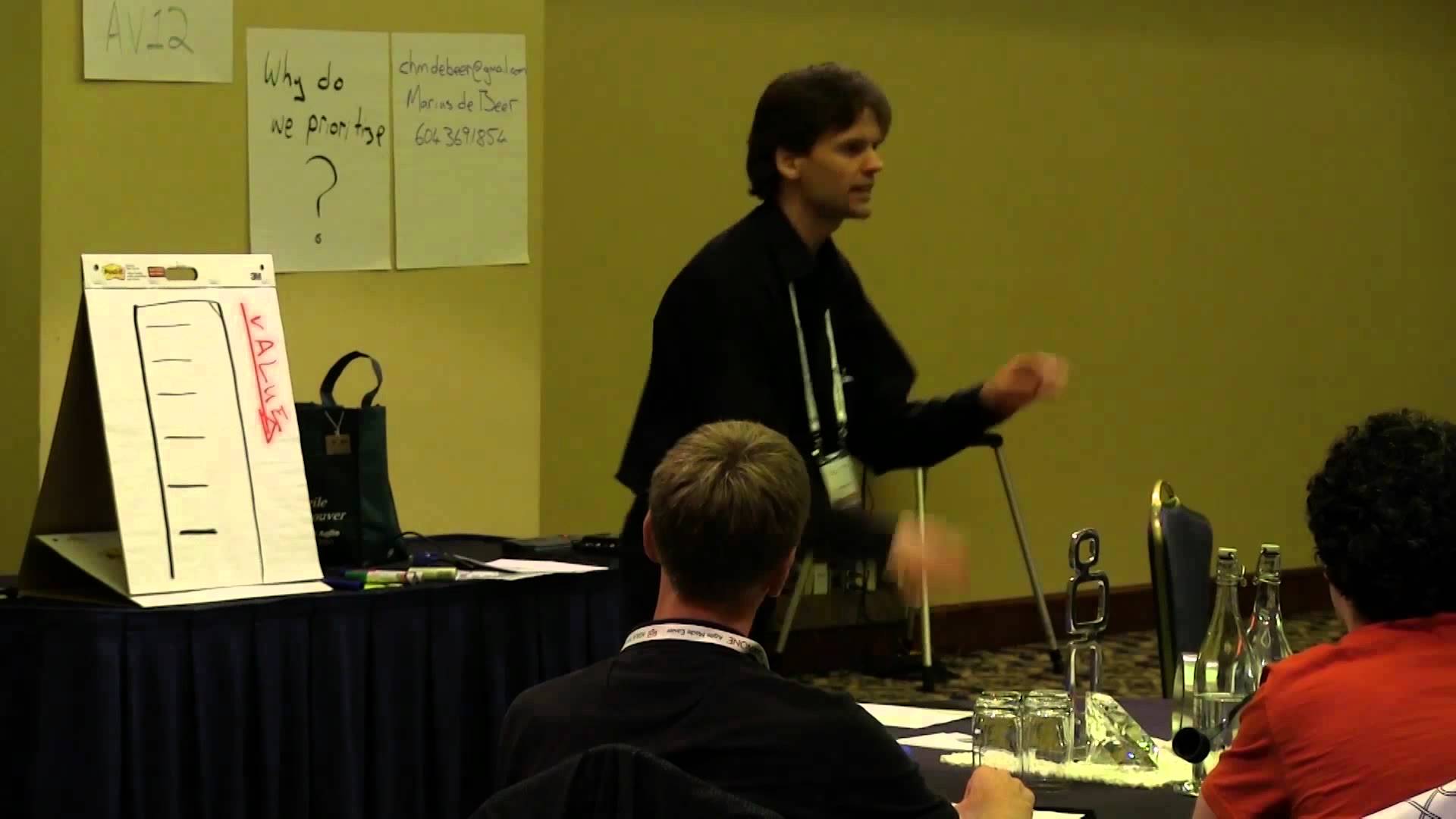
The prioritized product backlog is core to being Agile. A well prioritized backlog allows us to satisfy the customer through early and continuous delivery of valuable software at then end of each sprint in Scrum. Lean and Kanban may call it something else, but there too, prioritized work is key.
Soft factors include beliefs, character and attitude of people as well as the way we communicate. This presentation addresses for example: Why are we acting in a certain way? Who must change: Me or the other person? I “want” is better than I “must”. How to find out the true reason behind somebody’s behaviour? How can we win people instead of forcing them?
What is the key to high productivity via Scrum? According to Alex Brown, Chief Operating Officer at Scrum Inc., it all comes down to the retrospective and the “happiness metric.”
This short (and humorous) video presents the 3 most common mistakes and 5 best-practices to improve your Scrum Sprint Retrospective meeting.
Linda Rising shares influence strategies that you can use to more effectively convince others to see things your way. You’ve tried and tried to convince people of your position. You’ve laid out your logical arguments on impressive PowerPoint slides—but you are still not able to sway them. Cognitive scientists understand that the approach you are taking is rarely successful. Often you must speak to others’ subconscious motivators rather than their rational, analytic side.
It is fairly hard to know what solid software testing is all about within Agile and Scrum teams. What traditional software testing practices are fine to continue, which ones need modification and what totally new approaches are necessary. Moving from traditional testing to agile testing is often a high-wire balancing act to some degree with no clear direction.
Klaus Bucka-Lassen discusses the estimation with story points in Scrum. Story points are a different way to estimate features in Scrum. Story points are a measurement of a feature’s size relative to other features and not a measure of the time needed to complete a feature.