Articles and videos on creating and managing cross-functional Scrum teams: scrum master, product owner and development team.
Is hiring for an Agile team (team member, scrummaster or product owner) different than hiring for a software development organization that follows another approach? Scrum.org and McKinsey & Company have recently published the results of a joint study exploring the values and traits that make agile teams successful. The goal of this document is to help and guide organizations with concepts and ways to better recruit and coach their teams.
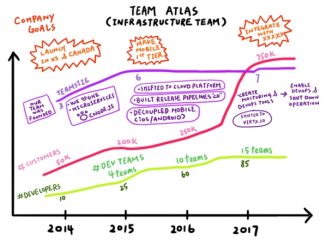
Agile and documentation are not two words that are often associated in articles or blog posts. Scrum teams have however to find alternate ways to spread the knowledge among their member. In this article, Viktor Cessan explains how he uses an exercise named History Lines to share knowledge in Agile teams.
At some point in your work as Agile coaches, you have to organize some kind of team building event. The brief you get is usually a combination of “fun” stuff with some “work” stuff mixed in. This talk share some alternative ideas for kicking things off with a Scrum team and creating a psychologically safe environment essential for collaboration, without cooking or paintball or escape rooms involved ;O)
The end of the year if often the time for performance reviews. Should you still do this practice when you have Scrum Agile teams where the global results should be more valued than the individual peformance?
Shifting responsibilities from a “command and control” organization towards self-organized teams is not easy. In her article “Managing Product Teams for Success”, Teresa Torres discusses the challenges that you face when you try manage product teams by outcomes.
The change required by Agile and Scrum isn’t simple. This talk presents the tools provided for six teams and they were enabled to build the foundations for safe continuous learning themselves. Most people in agile and lean are involved in change somehow.
Inspired by NASA astronaut training for solving complex, evolving problems on the fly, the Chaos Lottery is one approach to testing the resilience of a Scrum team. This is a story about knowing what you should do, and finding you are still not quite doing it.