Videos on Scrum and Agile Project Management
Many organisations have been swept up in agile process adoption, with good reasons! The Agile Party is coming to a close and many organisations are now beginning to look at where they are and have come to the disheartening realisation that, rather than in a new world of embracing change and competitiveness, they have a lot of new processes, not much to show for it, and people are disillusioned enough to begin to revert to older, familiar ways… This is the unfortunate age of the ‘agile hangover’.
For best results from Agile, you need a solid team. If you belong to, manage, or lead an Agile team, you’ve probably seen that process alone doesn’t translate to great results – and that having a cross-functional group of 7 +/- 2 “resources” doesn’t either. Instead, what makes Agile come to life is the team’s motivated, engaged individuals who communicate, collaborate, and respond effectively. In many organizations, teams rely on their leaders and managers to help them grow and become stronger.
Carbon Five has been using Agile XP from our very beginnings 14 years ago. Six years ago we started on a deep dive into Design Thinking inspired by collaborations with the Stanford d.school. We then extended those learnings, integrating Lean UX techniques, to help our clients focus the team’s development power in a direction more closely aligned to a viable product market fit.
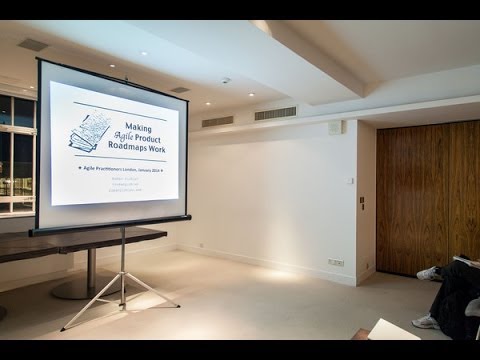
A product roadmap is a high-level plan that shows how a product is likely to grow over time. This creates a continuity of purpose, aligns stakeholders and facilitates prioritisation. Unfortunately, many product owners and teams struggle with their product roadmaps. The roadmaps are often dominated by features, and the features are sometimes regarded as a commitment by senior management.
Business Analysis (BA) is a growing profession which is helping organisations to manage business transformation in an ever changing and complex world. Business analysts work across the business change lifecycle; they develop early understanding of business needs so that the right projects are funded for the right reasons and ensure that the solutions are developed that meet these needs. As a result, the Agile philosophy and techniques are fundamental to business analyst’s work.
This talk provides a is a reflection on what Michael De La Maza has learned as an Agile Coach about communication, emotional stress and team organization.
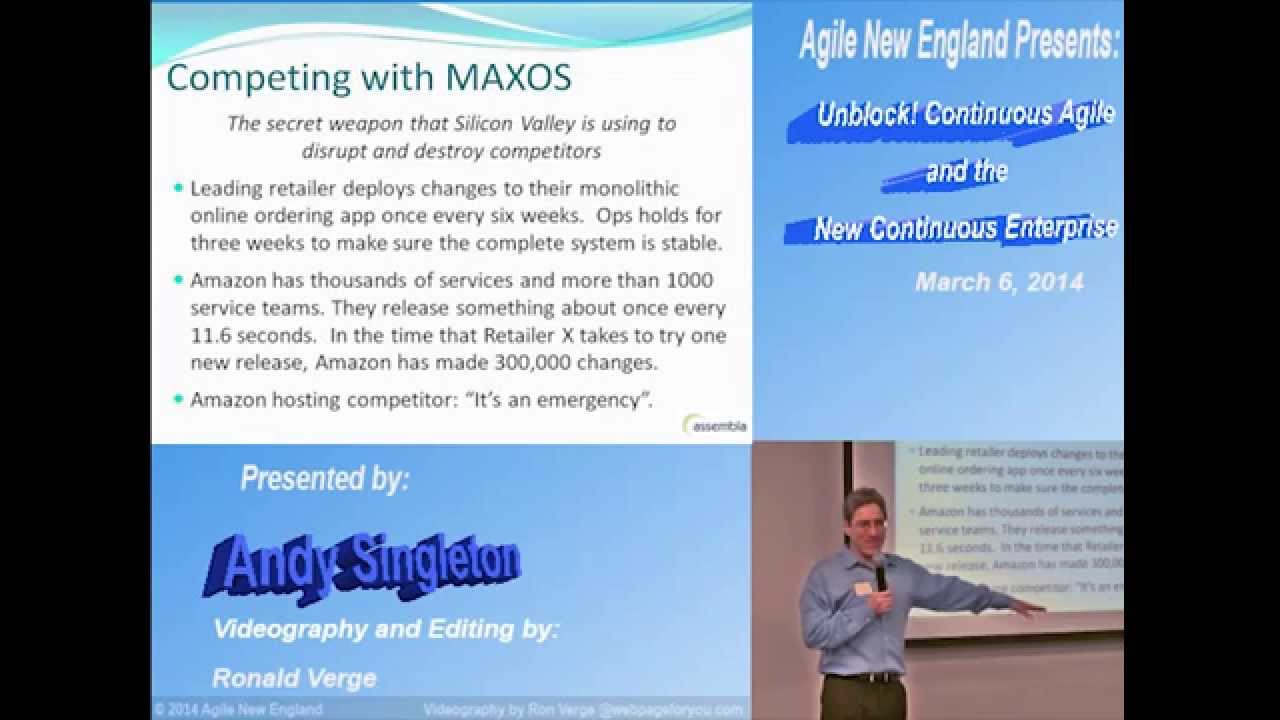
Some companies such as HubSpot or Google have developed techniques that allow small teams to create, test and deploy a continuous stream of releases. These companies are able to harness highly distributed Agile teams and scale to very large projects, while avoiding the tyranny of long meetings, conference calls, detailed estimates and sticky notes.