Videos on Scrum and Agile Project Management
This is a talk about how shifting the focus from craft to product has affected my company. Our delivery teams are required everyday to make trade offs between what would the best technical solution and the one that is right for the product they are delivering. Ultimately, we get paid to solve business problems, not to be perfectionists.
Agile reminds us that the focus of any set of requirements needs to be on an outcome rather than a collection of whats and whos. Storytelling is a powerful tool to elevate even the most diehard requirements analyst from a discussion of individual requirements to a discussion of outcomes. Outcomes are the big picture that acts as an anchor for whole efforts and which is continuously broken down into more and more detailed product backlogs.
Running an experiment is trivial: Make a change and see what happens. Running experiments at scale, however, is a different story. It is not trivial to simultaneously run hundreds of experiments across 100 million users. It’s not trivial to cover dozens of platforms and markets while staying on top of the technical and methodological complexities.
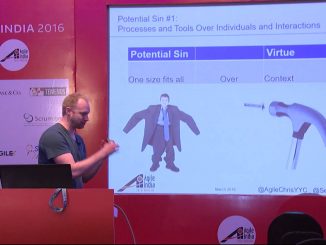
This is about agile “anti-patterns”: “something that looks like a good idea, but which backfires badly when applied” (Coplien). The presenter has been around Agile development from before it was called Agile. In that time, he has seen teams fall into the trap of many of these anti-patterns, becoming stuck without ever realizing it.
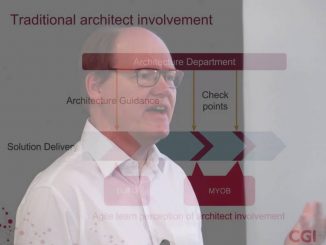
In the Agile world, software architecture is about making design decisions with just enough anticipation. Too much anticipation leads to overly heavy architectural constructs that may never be used (YAGNI); too little anticipation leads to expensive refactoring and potentially fatal build-up of technical debt. This session presents an approach for Agile architecture roadmapping with just enough anticipation.
Learn how to succeed with large scale Agile. Implementing Agile in small, short lived projects is easy. The real challenge comes when the project becomes long-running, and it gets even harder when spanning into multiple large projects. Add the challenge of distribution of resources and different cultures and it becomes almost impossible.
Learn which building blocks help you to create the culture of systematic improvement in a software development organization and a Scrum team. This talk discusses how the Deming cycle – Plan-Do-Check-Act has been applied concretely in an R&D organization to ensure that the operational development is done systematically. The practices have been evolving during couple of years and the talk will also share the lessons learned from this journey.