Videos on Scrum and Agile Project Management
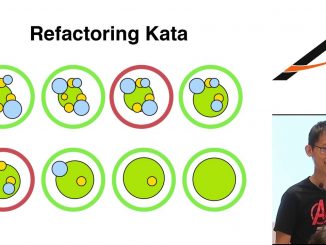
Agile technical practices like refactoring and TDD (Test-Driven Development) have become mostly mainstream in software development. However, software developers in many companies are either oblivious or have a different interpretation of these practices. As a software development coach, the interest of the presenter is to help developers adopt technical practices and being a mentor has played a big part.
Many Agile coaches are former software developers, some are not. But when technology moves on, well known Agile approaches can be challenged. Applying the Agile approach of vertical story slicing on microservices is one such example. This talk explains on how as Agile coaches we can coach in technical areas where technology may have moved on, thus challenging the perceived coaching approaches to helping teams become self-organising.
This talks discusses 7 deadly sins of software development, specifically relevant for Agile teams. It’s pretty clear when you fail as a start-up, where you and your friend invested last savings. The product is not ready or just doesn’t get sold, the money’s gone, you open LinkedIn to search for a job suitable for an “experienced software engineer with entrepreneurial background”. It is way more tricky in a big company with a well-established product.
An important part of agile leadership is improving communication between people. M. Spayd and M. Hamman are talking about shifting from directive – “managing for results” leadership style to catalysing – “designing environments that create results” style. Lyssa Adkins recommends avoiding asking ”Why don’t you…?” questions when coaching, as being too offensive.
Scrum is becoming very popular and this iss good. Consciously or not, most people adopt Scrum by blindly following a so-called Scrum expert; that’s not so good. As more organisations look to an Agile transition to become more efficient, I am keen to make sure that they realise that there is more to Agile than just Scrum.
Individuals and interactions over processes and tools” how often have you heard this phrase from the Agile Manifesto? I strongly believe in it however we see that a good balance between the two parts is the key to succeed. As the Agile Manifesto says “That is, while there is value in the items on the right, we value the items on the left more”.
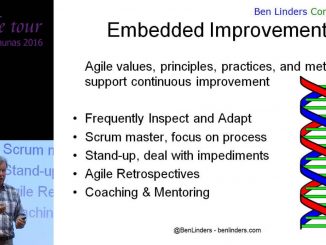
This talk explains the need for continuous improvement when adopting agile ways of working. It explores how continuous improvement is fundamental in agile, and what you can do to increase the agility of your teams and the organization as a whole.