Articles, Blog Posts, Books and Quotes on Agile Project Management
The Product Owner Manual is a short e-book available for free from ScrumSense. It discusses in a practice-oriented way the roles and techniques used by a product owner in Scrum teams, including the story writing principles and how to perform release planning.
As Agile product and project management approaches are adopted by large organizations, they have to coexist with a typical entity of big companies: the Project Management Office (PMO). A recent report from ESI International explores how the PMO staff views the challenges of implementing Agile in their organizations.
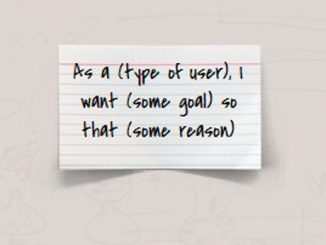
Agile requirements are a key success factor for Scrum projects. Many people criticize the minimalist format of user stories, often forgetting that they are mainly a support for a conversation and don’t have the objective to fully document requirements. In this article, Paul Raymond discusses how classical use cases can be use to expand user stories during requirements elicitation in Scrum sprints.
Written by South African Agile coaches Samantha Laing and Karen Greaves, “Coach’s Guide to Agile Requirements” is a book on how to teach the concepts of Agile requirements. It provides a complete plan to run a workshop where people can learn how to elicit, refine and organize requirements in an Agile way.
Technical Debt is defined as the consequences of poor software architecture and software development within a codebase. Carrying too much technical debt reduce the ability of software to change and evolve. In this article, Jurgen De Smet explains how to manage technical debt from a business perspective.
It’s all too common these days to see arguments on Twitter or mailing lists with these rules-bound zealots arguing that ”you’re not agile” because you aren’t following the rules to their satisfaction.
Using Story points is a technique used by Scrum team to evaluate the relative size of user stories. If this technique works fine for single teams, it might be more problematic when multiple teams are involved. In this article, Paul Raymond explains why user story normalization is needed in contexts where multiple Scrum teams cooperate on the same user stories.