Articles on Scrum and Agile Project Management
Sprint retrospectives are an important tool for Agile software development teams that want to implement continuous improvement and adjustment to their working context. In this article, Jesus Mendez provides some techniques that could help improving the outcome of your Sprint retrospectives.
The Minimum Viable Product (MVP) is defined in Wikipedia as “a product which has just enough features to gather validated learning about the product and its continued development.” In this article, Sergiy Andriyenko proposes fives rules to apply successfully a Minimum Viable Product strategy.
If the basic principles of the Agile Manifesto and the Scrum framework are simple managing global Agile software development projects in the corporate world is sometimes more complex and complicated. This article lists some approaches that have been created to answers the specific questions raised by scaling Agile practices in large organizations.
One of the most important, and often overlook, sentence in the principles of the Agile Manifesto is “continuous delivery of valuable software”. Delivering value is an important principle for Agile and prioritization is the tool that allows to deliver value quickly. This is the topic discussed by Daniel Zacarias in his article “20 Product Prioritization Techniques: A Map and Guided Tour”.
Story point is a arbitrary relative measure used by Scrum teams to define the effort required to implement one story. In this article, Mahfoud Amiour proposes an approach to measure the cost of story points implementation.
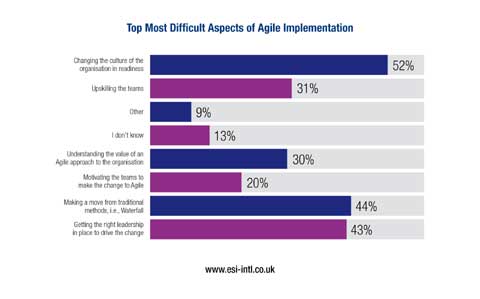
As Agile product and project management approaches are adopted by large organizations, they have to coexist with a typical entity of big companies: the Project Management Office (PMO). A recent report from ESI International explores how the PMO staff views the challenges of implementing Agile in their organizations.
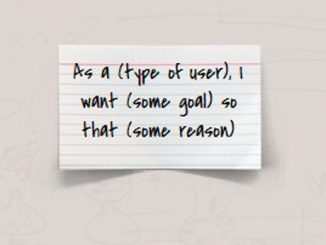
Agile requirements are a key success factor for Scrum projects. Many people criticize the minimalist format of user stories, often forgetting that they are mainly a support for a conversation and don’t have the objective to fully document requirements. In this article, Paul Raymond discusses how classical use cases can be use to expand user stories during requirements elicitation in Scrum sprints.