

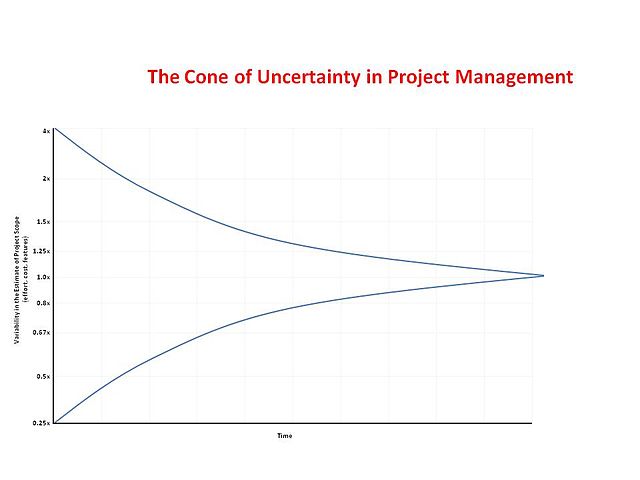
Uncertainty in the Product Backlog is a big risk for the schedule of a Scrum project. How clever your estimations might be, Agile has to consider them using the notion of “cone of uncertainty”.
The problem when trying to plan in Scrum is that the full scope of the release in Agile software development can be quite hard to estimate. This is due to the fact that the requirements are intentionally not well-know early on in the process. Confounding this problem is that frequently the release date is a hard deadline.
This means that an Agile team must perform an unknown amount of work in a fixed amount of time. The “Cone of Uncertainty” describes the reduction of the uncertainty about scope after each Scrum sprint. It is only at the end of an Agile project that you eliminate the uncertainty and know the exact amount of scope is known.
In anticipation of scope problems in project management, the software development schedule should be aligned to address the highest priority feature sets and features in early iterations. You defer lower priority feature sets and features to later iterations. To reduce the Cone of Uncertainty and the risks around missing a release deadline further, the requirements lead (product owner) and the Scrum team should actively defer low priority features from all feature sets to later sprints.

These are the key considerations and decision points for reducing the Cone of Uncertainty in Agile:
- Primary goal: reduce dangerous uncertainty (feasibility, integrations, regulatory risk) while keeping most of the discovery for user needs.
- Timebox: plan 1–3 spikes (each 2–5 days) in Sprint 0/1 to validate the initial assumptions.
- Stakeholder alignment: get a single accountable Product Owner and a one‑page Product Vision before sprint planning
This avoids the case of being unable to release a minimally acceptable product, because time was spent on low priority user stories / features from high priority feature sets when it could have been spent on all individually high priority features across feature sets. Applying Agile and Scrum properly benefits software development organizations by helping them to address the cone of uncertainty.
It reduces uncertainty sometimes associated to traditional (waterfall) project management approaches. In these contexts, the software development team delivers the product only at the end of the project after weeks, months or years of development. They empower software development teams to deliver business value.
With Agile, the estimation error normally goes down iteration after iteration (again, if the project is well managed) as the Scrum team delivers an increment of business value at the end of each sprint.
More references on the Cone of Uncertainty in Project Management & Scrum
The Cone of Uncertainty (Construx)
Agile and Dealing With The Cone of Uncertainty
The Cone of Uncertainty and its Usage in Scrum
The Mysterious Cone of Uncertainty
Harvard Business Review: Six Rules for Effective Forecasting
Fingers in the air: a Gentle Introduction to Software Estimation
Cone of Uncertainty is another reason why we need to deliver early and often
Learn About the Cone of Uncertainty Framework
Videos about the Cone of Uncertainty in Scrum
The Cone of Uncertainty by Steve McConnell
Forecasting and the Cone of Uncertainty
Cone of Uncertainty in the Scrum and Agile Methodology – Product Requirements